
Blog
By Bruce Robertson

What Makes A Great Lesson?
This week, I was invited to be a guest on a new podcast about Scottish education (‘Two Heads Are Better Than One’ – check it out: it’s good). The main theme was ‘What makes a great lesson?’, which is the question I was asked to unpack. I was very happy to do this because I think it’s an essential question for everyone who works in education to keep coming back to. However, I don’t think it is one that gets discussed often enough.

The Scottish ‘Curriculum for Excellence’: A Good Example of What NOT To Do
In Scotland, in theory, there is a national curriculum. On paper, there certainly appears to be. This is set out as a framework of ‘Experiences and Outcomes’, organised by ‘curricular areas’ and ‘levels’. Here is a snapshot of what this looks like: …

Moderation Delusions
Teachers’ time is too precious to waste. However, in too many schools, that is precisely what’s happening. Instead of having time to discuss important things like the content of the curriculum or to develop their pedagogical knowledge and skills, too many teachers are being expected to focus on pointless exercises, such as ‘moderation of achievement of a level’ in the Broad General Education (3-15) phase of education in Scotland.

Lesson Observations: Too Important Not To Get Right
Lesson observations have the potential to offer invaluable professional learning to both teachers and school leaders. Through the process of watching a teacher teach, teachers and school leaders alike can develop and refine their understanding of what makes great teaching. Depending on its quality, the conversation that teachers have with professionals who have observed them teaching can help to transform their teaching practice.

The Importance of ‘Learning Gain’ Starters
Many schools insist that lessons begin with a ‘starter’. However, including a starter for the sake of it is rather pointless. Pointless starters are ‘non-gain starters’ – neither students nor the teacher gain anything from them. They are included with the sole purpose of keeping students busy as others arrive, settling the class, or beginning the lesson with something ‘fun’. Typically, they take the form of puzzles or games. Often, there is a loose link to learning, but this just disguises their non-gain nature.

A Short Post About Assessment & Progress
When we talk about how students are doing at school, we often do so in terms of progress. ‘Andrea is making good progress’ or ‘James isn’t making as much progress as we’d like him to be making’ are the sorts of statements parents are likely to read in reports or hear in discussion with a teacher. Most parents are satisfied with their child’s learning being summarised in this way. But should they be? Let’s explore this.

What Should We Include In Our Curriculum?
Arguably, all knowledge has value. However, it’s clearly impossible for schools to teach students everything. Decisions need to be made. But how do we make them? Let’s start to explore this idea via a discussion of ‘useful’ and ‘interesting’.

Feedback: Focus on ‘Useful’, Which Means Focus on ‘How’
While learning can happen without feedback, it will always tend to be better when feedback is involved. The less expert anyone is in any area, the more important is feedback from an expert. Feedback is top of the list of the Education Endowment Foundation’s practices that make the biggest difference to student learning.

A Three Minute Guide To… Independent Learning
For some, ‘independent learning’ is the holy grail of education. Teaching students how to learn by themselves, without the need for teachers, is what they believe schools should be aiming to do.

Curriculum Planning: Macro, Meso & Micro
Content is the curriculum. Therefore, curriculum planning needs to focus on content. Curriculum planning needs to start with the big picture and work its way in. At a school level, this means considering what the purpose of your curriculum is – what some people call a ‘rationale’. What is it that your curriculum should be focusing on teaching your students, and why?

A Five Minute Guide To… Differentiation
Students are all different. They arrive at our lessons knowing and being able to do all kinds of different things. This is entirely natural and something we will never be able to change. Which is fine – difference is very often a good thing!

A Five Minute Guide To… Cognitive Load Theory
Thinking takes place in working memory. However, our working memory is limited both in terms of the space it has to think and how long it can hold information. These limits are the bottleneck of learning. Cognitive Load Theory explores the limits of working memory and how these can be overcome.

The Importance of A Knowledge-Based Curriculum
Establishing a Professional Reading Group in your school can be one of the best things you can do to develop a shared understanding of what great teaching looks like. I discussed this as part of the Teaching-centred Leadership chapter of The Teaching Delusion.

A Five Minute Guide To… Knowledge vs Skills
Any debate about whether skills are more important than knowledge – or vice versa – is a false one. Both are equally important. We teach students knowledge so that they can ‘do things’ with it. The catch-all term for ‘do things’ is ‘skill’.

Teaching-Centred Leadership in Practice: a Professional Reading Group
Lesson observations have the potential to offer invaluable professional learning to both teachers and school leaders. Through the process of watching a teacher teach, teachers and school leaders alike can develop and refine their understanding of what makes great teaching. Depending on its quality, the conversation that teachers have with professionals who have observed them teaching can help to transform their teaching practice.

The Capital of Australia: The Power of Show-Me Boards
Asking questions is one of the most important things a teacher can do to help students learn and to check their learning. If you ask a student a question, it requires them to think. To give you an answer, they need to recall information. Their answer gives you feedback about what they know and understand, and what they don’t. You can then use this to give feedback to them, or to make teaching points to others that you might not have considered otherwise. Asking questions is a powerful formative teaching practice.

The Forgetting Pit
What is learning and how does it happen? These are key questions for anyone involved in education. In The Teaching Delusion, as many authors have before me, I discuss learning in terms of long-term memory. However, in this blog post I would like to consider learning in a related but different way. I would like to consider learning in terms of a Forgetting Pit.

A Five Minute Guide To… Feedback
Most of the schools I work with identify ‘feedback’ as something they want to improve. However, there are two common mistakes that they make when thinking about this:
They think about feedback as being ‘a thing’ in itself, rather than being a continuous, integral feature of the teaching-learning process.
They think about feedback as something which teachers give to students (or students give to other students) – which it is – but forget to think about the importance of the teacher getting feedback from students, in response to evidence of learning.

The ‘Perfect Lesson Rainbow’
Think about the last lesson you taught. Was it a successful lesson? Why do think that?
Ask a random room of teachers if these are important questions to think about – most will say ‘yes’. Ask the same room of teachers what their answer to the second question is and you are unlikely to get the same consensus. Some will say, ‘Because I got through everything that I’d planned to get through’, others that, ‘All of the students seemed to enjoy the lesson,’ and some that, ‘All of the students were well behaved and did what I asked them to do.’ Such things being the case, do they equate to a successful lesson?
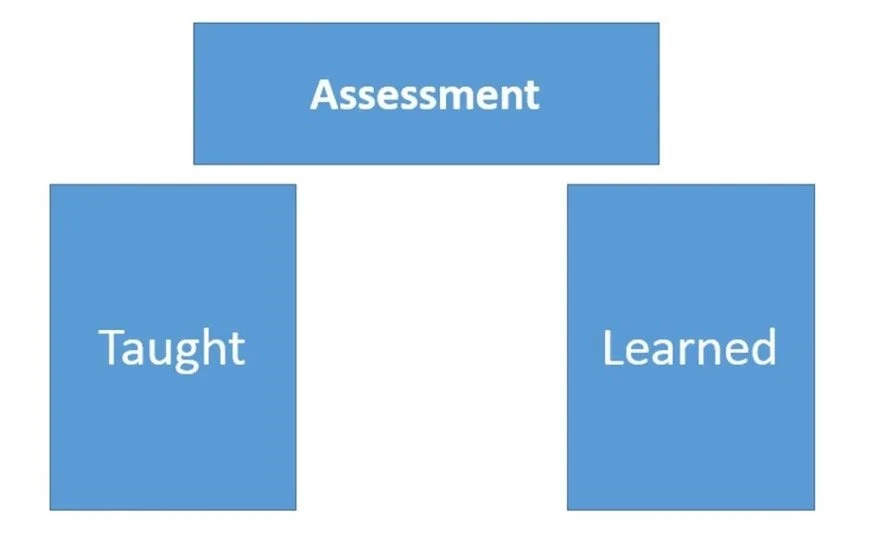
The Teaching-Learning Gap
Education is full of ‘gaps’. People often talk about the ‘attainment gap’ or the ‘achievement gap’. However, the most important gap for teachers and school leaders to be thinking about is the ‘teaching-learning gap‘.